

Fans of every team, in every sport, believe that the officials are out to get them. When a big call goes against your team, the referees are the easiest scapegoat imaginable.
Oregon State fans likely feel that way today. That's because an unusual penalty call went against their team and saved Texas Tech from being upset on Saturday night. However, a closer examination of the play makes it hard to argue that the call was anything but correct.
With 1:30 remaining in the contest, Tech was protecting a 28-24 lead. That's when Oregon State QB Braden Atkinson connected with receiver Aeryn Hampton for a 30-yard completion on fourth down. That play appeared to set the Beavers up with a first down at the Texas Tech 49. Considering that the home team still had a pair of timeouts left, they would have had plenty of time to march toward the end zone, especially considering how the OSU passing attack carved up the Red Raider secondary all night.
However, Tech was saved by an uncommon penalty. The Beavers were penalized ten yards for offensive pass interference. That sent the home crowd and people around the nation rooting for an upset into a frenzy.
A big 4th down conversion was called back for offensive pass interference on Oregon State.
— CBS Sports College Football 🏈 (@CBSSportsCFB) September 13, 2026
Our crew discusses the call. pic.twitter.com/bWMNfMyFP2
On the ensuing fourth-down play, Tech came up with the stop and took over deep in OSU territory. Three plays later, a TD pass from Tommy Castellanos to tight end Matt Ludwig sealed the victory for head coach Joey McGuire.
In the hours after the game, fans across the college football world have been debating whether the penalty was warranted, and most believe that it wasn't. However, that's human nature because most people with no emotional stake in the game pull for the upset, which clouds their judgment of any game-defining call that goes against the underdog. A close examination of the play, though, shows that it was the correct call.
The call that saved Texas Tech was correctly made
One reason why the penalty was so controversial is that most football games go by without an offensive pass interference flag. So when one is thrown for that infraction at a critical time in a close game, fans are going to insist that the refs shouldn't make that call at that moment.
Of course, that's absurd. A penalty is a penalty and should be called regardless of the game situation. That's true in any sport.
What's more, any logical fan can see that Oregon State had two receivers commit offensive pass interference on that play.
According to the official NCAA rule book, "Offensive pass interference is contact by a Team A player beyond the neutral zone that interferes with a Team B player during a legal forward pass play in
which the forward pass crosses the neutral zone. It is the responsibility of the
offensive player to avoid the opponents."
The final line of the above paragraph is the key to this play. There were two Oregon State players who simply went crashing into Texas Tech defenders while making no attempt to avoid them. That helped free up the receiver who made the catch.
Neither of the outside receivers on the play actually ran a route. They just impeded Texas Tech defenders.
The most egregious was No. 12, Jesse Legree, who made contact with Texas Tech corner Davin Martin, who was in coverage against Hampton, the eventual receiver. Because of the contact that Legree initiated, Martin was unable to stay with Hampton, leaving the Oregon State receiver wide open. That's illegal.
Some who look at the replay are arguing that Martin extended his hands to initiate contact with Legree. However, that is a natural human reaction to being run into. Had Legree not been barreling toward Martin, the Red Raider corner would not have had to put his hands out to protect himself.
Ultimately, there was no route run by Legree or the receiver outside of him in the formation, Aaron Butler. What's more, neither did anything to try to avoid contact with a Tech defender. Therefore, the officials had no choice but to throw the flag.
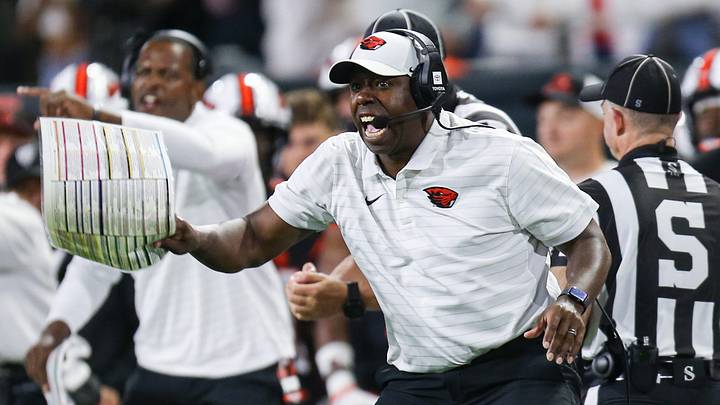
Surprisingly, after the game, Oregon State head coach JaMarcus Shephard took the high road. Though he was visibly angry when the call was made, he didn't attribute the loss to that moment.
"I didn't think it was pass interference," he said in his postgame remarks. "But that's what they called, so we got to move on...There were a number of different calls that would have given our team a chance to win the game, such as when they muff a punt; our guys have to be in front of them so we have a chance to freaking recover it. So we had a number of plays; you can't just point to one thing and think that's the difference in the game."
Yes, it was a bang-bang play, but the officials got it right. That's what CBS Sports officiating analyst and former NFL referee Gene Steratore said on the broadcast, and it is a reality that college football fans around the country will have to come to accept.
 Add us as a preferred source on Google