

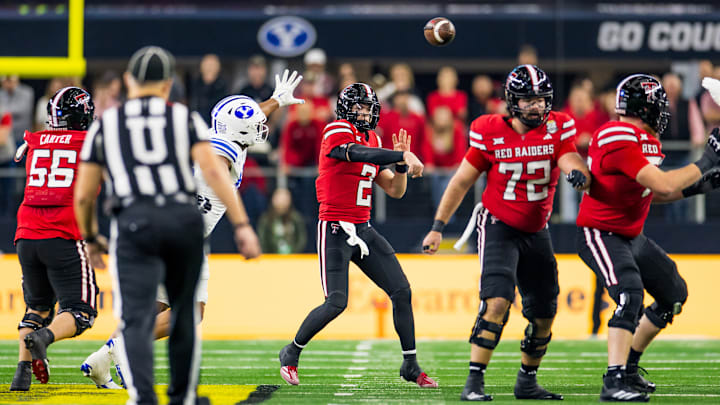
The Texas Tech Red Raiders are better than just about everyone when it comes to throwing the ball. Just about everyone. There are 134 college football teams playing at the FBS level. The fact that the Red Raiders are in the top 10 points to the fact that their passing attack is an elite one.
But, technically speaking, it’s worth pointing out that there are a few teams that happen to be better at throwing the ball than the Texas Tech Red Raiders. In fact, there are eight. Now, that’s not a big group, but it’s big enough to include one other contender that remains active in the College Football Playoff.
Assuming I’m counting correctly, that means that there are six CFP contenders that are worse than the Red Raiders when it comes to throwing the ball.
Among College Football Playoff contenders, only the Ole Miss Rebels throw for more yards per game than the Texas Tech Red Raiders
Here’s how the remaining eight College Football Playoff teams stack up when it comes to passing yards per game:
- Ole Miss Rebels - 312.4 passing yards per game - No. 3 overall
- Texas Tech Red Raiders - 289.4 passing yards per game - No. 9 overall
- Alabama Crimson Tide - 270.2 passing yards per game - No. 21 overall
- Ohio State Buckeyes - 266.8 passing yards per game - No. 23 overall
- Miami Hurricanes - 262.5 passing yards per game - No. 29 overall
- Oregon Ducks - 251.8 passing yards per game - No. 41 overall
- Indiana Hoosiers - 251.6 passing yards per game - No. 42 overall
- Georgia Bulldogs - 220.3 passing yards per game - No. 75 overall
It’s interesting to me to see how there are clearly a number of teams in the College Football Playoff that don’t highly prioritize throwing the ball around a bunch. Just two are in the top 10. Half of the teams that remain are in the top 25 nationally, but then after that, it drops off pretty quickly.
Also, the gap between the Georgia Bulldogs and the Indiana Hoosiers feels massive when you look at where they’re ranked, but it’s interesting to see how (at least in terms of production) that gap isn’t that much larger than what we’re seeing from Texas Tech and Miami.
 Add us as a preferred source on Google