

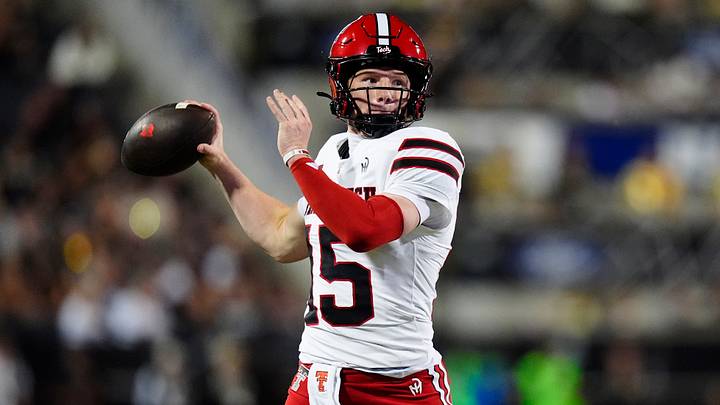
This weekend, the Texas Tech football team is enjoying a much-needed open date. While that provides the team time to heal and refresh, it also gives the Red Raiders time to evaluate themselves and try to improve in critical areas.
One player that fans hope comes out of the gates strong next Saturday is, of course, first-time starting QB Will Hammond. That's because there is a growing narrative around Raiderland that he has been a disappointment thus far. However, that belief is a bit unfair. What's more, fans should be less eager to write off Hammond as a viable long-term solution at the game's most important position.
Through five games, Hammond has thrown for 1,102 yards and five touchdowns while being intercepted five times. He's averaging just 220.4 yards per game through the air, a number that feels low given the video game statistics the current generation of Red Raider fans have seen their QB's put up in the modern era of the program.
Therefore, after less than half of a season, many are already questioning if Tech should look for Hammond's replacement in the offseason. Some even want to consider starting backup QB Tommy Castellanos if the senior has his eligibility restored by the court system.
While there is no doubt that Hammond has room for improvement, especially when it comes to taking care of the football, level-headed Red Raiders should keep in mind that he is just in the infancy of his career as a starting QB. What's more, Hammond missed most of the offseason while recovering from a torn ligament in his knee. That robbed him of invaluable developmental opportunities during spring practices and over the summer.
Therefore, anyone who assumed Hammond would resemble Patrick Mahomes II right out of the gates was living in a fantasy. There was always going to be a learning curve for any first-time starter, and Hammond should be afforded time to grow in that role.
The good news is that he's shown signs of having the necessary tools to be a reliable starting QB. In fact, some of his numbers this season are comparable to the numbers Graham Harrell posted in his first season as Tech's starting QB.
Hammond's advanced stats compare favorably to Texas Tech legend Graham Harrell in 2006
At first, it might seem sacrilegious to compare 2026 Hammond to Harrell, who is the most accomplished QB in Texas Tech football history (at least at the collegiate level). After all, even as a first-time starter in 2006, Harrell averaged 350.4 yards per game through the air while passing for 35 TDs and only 11 picks in his redshirt sophomore season, 2006.
However, that was a different era of the game when the "Air Raid" offense of then-head coach Mike Leach was taking college football by storm. At that time, few defenses in America knew how to stop Tech's innovative, wide-open passing attack, and as a result, Leach and Harrel put up stunning numbers.
Additionally, Harrell was surrounded by far more offensive talent in 2006 than Hammond is in 2026. That season, Harrell was throwing to legendary Red Raider receivers such as Joel Filani, Robert Johnson, Danny Amendola, and Jarrett Hicks. Also, blocking for Harrell was one of the nation's top offensive lines, one that included program greats Louis Vasquez and Manny Ramirez at the guard positions.
Still, Harrell had his struggles at times that season. In a 38-21 home loss to Missouri, Harrell threw a pick-six on consecutive first-half possessions as Tech fell behind 24-0. During that game, he was booed by the home fans and was seen giving fans behind the Tech bench the double bird.
One week later, in a 30-6 loss at Colorado, which entered the game 0-6, he was picked off three times while throwing just one touchdown. That day, he threw for only 236 yards, a terrible total for a Mike Leach quarterback.
After those two rough starts, though, Harrel found his footing. In the last six games of the season, he led Tech to a 4-2 record and had no more games with multiple interceptions. Of course, he would eventually build on his up-and-down 2006 season to have the best career of any QB in Texas Tech history.
While no one is suggesting that Hammond is destined to be the next Harrell, fans should learn from Harrell's first season as the starting QB and understand that star quarterbacks aren't usually built overnight. What's more, a look at some advanced stats shows that Hammond is actually performing as well this season as Harrell did twenty years ago.
Thus far, Hammond is completing 68.3% of his passes. That's better than the 66.8 that Harrell completed in 2006.
Additionally, Hammond is pushing the ball down the field better. His average yards per completion is 7.8, which is almost half a yard better than Harrell's 7.4 as a sophomore.
Similarly, Hammond is averaging 11.4 yards gained per completion, 0.3 yards better than Harrell in 2006. Finally, Hammond's passing efficiency rating of 138.1 is not too far from the 145.5 Harrell put up in his first season as the starter. In fact, if Hammond takes better care of the football in the final seven games, those numbers will likely end up being much closer.
What is important about the advanced stats is that they take the factors beyond a player's control, factors such as offensive scheme, play calling, etc., out of the equation. That allows us to have a more nuanced look at how players compare to one another.
Speaking of play calling, many Red Raiders are convinced that 2026 offensive coordinator Mack Leftwich is terrible at his job. That is another factor working in Hammond's favor when comparing him to 2006 Harrell, who was coached by Leach and co-offensive coordinators Sonny Dykes and Dana Holgorsen, two future Big 12 head coaches.
In other words, if one believes Leftwich is not a quality OC, then one must also concede that coaching might be a factor in Hammond's slower-than-expected start to 2026. That wasn't a problem for Harrell two decades ago.
One key difference in 2026 is that expectations are elevated for this program. Therefore, today's Tech fans have more urgency and less patience, given that nothing short of a Big 12 title will satisfy.
However, we must not be so quick to write off Hammond as a viable starting QB of the future. Harrell was allowed to grow into a star despite some rough patches as a first-time starter, and who knows, Hammond might do the same if given the opportunity.
 Add us as a preferred source on Google